Small Changes, Real Relief: 10 Ways Social Workers Can Use AI to Make the Day Easier
Simple ways social workers can use AI to make their day easier without changing their practice, their ethics, or their judgment

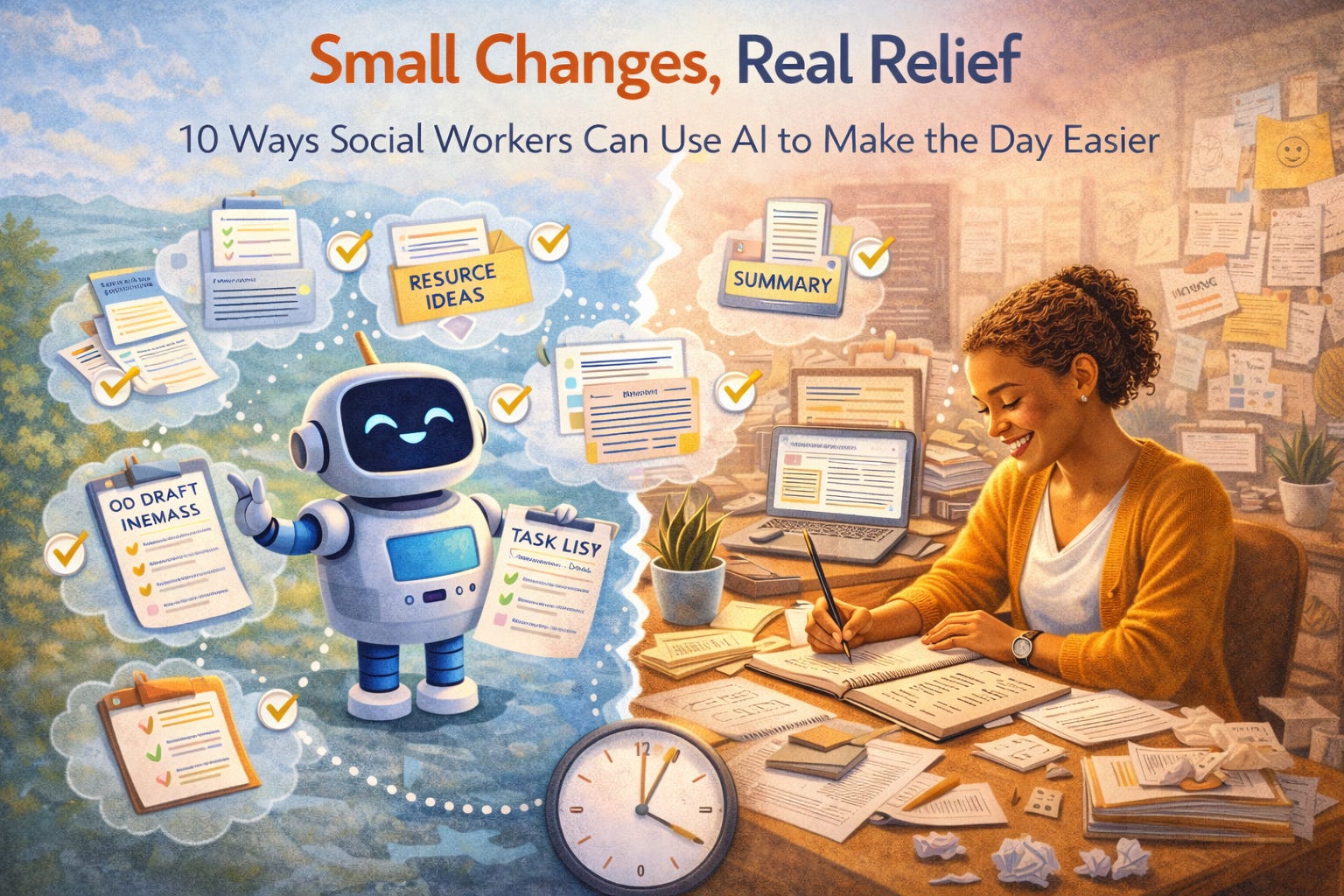
There is a quiet kind of exhaustion that comes with social work that is not always visible from the outside. It is not just the emotional weight of the work, though that is certainly real. It is also the accumulation of small, persistent demands that fill the spaces around direct practice. The emails that need to be answered. The notes that need to be written. The documents that need to be reviewed. The materials that need to be created. None of these tasks are inherently overwhelming on their own. But together, over time, they create a kind of cognitive load that is difficult to sustain. This is where the conversation about artificial intelligence often begins to surface. Not as a sweeping transformation of practice, but as a question that feels much more immediate: Can this help me get through my day more efficiently without compromising the work that matters most?
For many social workers, the hesitation is understandable. The field has always been grounded in human connection, ethical responsibility, and careful judgment. The idea of introducing a tool that generates responses quickly and confidently can feel misaligned with those values. At the same time, there is also curiosity. A recognition that if used thoughtfully, AI might offer some relief in areas that do not require deep clinical engagement. The key is not to think of AI as something that changes your practice. It doesn’t need to. Instead, it can be understood as something that supports the structure around your practice. It can help with the tasks that take time but do not require your full professional judgment. It can create small pockets of efficiency that, over the course of a day or a week, add up to something meaningful. These are not dramatic changes. They are small wins. But in a profession where time and energy are constantly stretched, small wins matter.
The first of these small wins is in organizing your thoughts before you write. Many social workers spend time staring at a blank screen, trying to figure out how to begin an email, a report, or a set of notes. The content is there but translating it into structured language takes effort. AI can help by turning rough ideas into a basic outline or draft. You can enter a general description of what you need to communicate, being mindful of confidentiality, and ask for a simple structure. This shifts the task from starting from nothing to refining something that already exists.
The second small win is in drafting routine communication. Emails to colleagues, scheduling follow-ups and general updates. These are necessary but often repetitive. AI can generate a professional, clear draft that you can then adjust to match your tone and intent. The key is that you remain the author. The tool provides a starting point, not a final product. This can save time without changing the substance of your communication.
A third area where AI can help is in summarizing information. Social workers are often required to review policies, reports, or training materials. These documents can be long and dense, and extracting key points takes time. AI can assist by summarizing general, non-confidential documents into more manageable sections. This does not replace reading the material, but it can make the process more efficient by providing an overview that helps you focus your attention.
Another practical use is in generating ideas for educational or informational materials. Whether you are preparing a group session, developing handouts, or creating content for clients, coming up with ideas can take time. AI can provide a list of general topics, activities, or discussion points that you can then evaluate and adapt. This can be especially helpful when you are feeling mentally fatigued and need a starting point.
A fifth small win is in rephrasing or simplifying language. Social workers often need to communicate complex ideas in ways that are accessible to different audiences. AI can help translate technical or formal language into something more conversational and clearer. This can be useful when preparing materials for clients or when trying to ensure that communication is inclusive and understandable.
The sixth area is in organizing tasks and priorities. AI can help you think through your day by generating a structured to-do list based on general responsibilities. You can describe your workload in broad terms and ask for help organizing it into manageable steps. This does not replace your own judgment about priorities, but it can provide a framework that makes the day feel more structured.
A seventh small win is in preparing for meetings. Whether it is supervision, team meetings, or community collaborations, preparation takes time. AI can help you outline key points, questions, or goals for the meeting. This can make the conversation more focused and productive, without changing the content of what you bring to it.
An eighth use is in brainstorming solutions to general challenges. Sometimes, the value is not in finding the right answer, but in generating multiple possibilities. AI can offer a range of ideas that you can then consider and refine. This can be particularly helpful when you feel stuck or when you need to think through a situation from different angles. The important part is that you remain the decision-maker. The tool provides options, not conclusions.
The ninth small win is in supporting professional development. AI can generate reflective questions, summarize articles, or suggest areas for further learning. This can make it easier to stay engaged in ongoing development, even when time is limited. Again, the tool supports the process, but it does not replace the deeper work of reflection and growth.
The tenth and perhaps most important small win is simply reducing the friction of everyday tasks. When small tasks become easier, even slightly, it creates more space for the parts of the work that require your full attention. It allows you to be more present in interactions, more thoughtful in decision-making, and less overwhelmed by the volume of work that surrounds those moments.
At the same time, it is important to maintain clear boundaries. These small wins only remain beneficial if they are used appropriately. AI should never be used to process identifiable client information, make clinical decisions, or replace professional judgment. These are not areas where efficiency should be prioritized over ethics. The goal is not to do the work faster at any cost. It is to support our work in ways that preserve integrity. Social workers need to remain engaged in the thinking process, even when the tool is providing support. The goal is not to outsource thinking, but to reduce unnecessary effort in areas that do not require it.
It is also worth acknowledging that these small wins are not about keeping up with technology for its own sake. They are about making the work more sustainable. Social work is demanding, and anything that can reduce unnecessary strain is worth considering. In many ways, people are already using AI to simplify their lives, often without even thinking about it. When a phone suggests the next word in a text, when an email platform drafts a quick reply, when a navigation app reroutes around traffic, or when a streaming service recommends what to watch next. These are all forms of AI quietly reducing cognitive load. Even more intentionally, people use tools to summarize articles, generate shopping lists, plan travel, or organize their calendars. The difference in professional practice is not whether AI is being used, but how consciously and responsibly it is applied. The same principle holds true in social work: when used thoughtfully, AI can take pressure off routine tasks, freeing up mental and emotional energy for the parts of the work that require presence, judgment, and human connection.
Choose one area where the risk is low and the potential benefit is clear. Try it out. Reflect on how it works for you. Adjust as needed. There is no need to adopt everything at once. In fact, doing so would likely create more confusion than clarity. Over time, these small adjustments can add up. They can create a sense of ease in areas that once felt burdensome. They can free up time and energy for the parts of the work that matter most. And they can help social workers engage with technology in a way that feels aligned with their values, rather than in conflict with them. The conversation about AI does not need to be overwhelming. It does not need to be all or nothing. It can begin with small, thoughtful steps that make the day just a little bit easier. And in a profession where the work is already heavy, that is more than enough.
Don Phelps, Ph.D., LCSW, CCTP
Author Note: Portions of this article were developed with the assistance of generative artificial intelligence as a writing and editing tool. The ideas, structure, and final content reflect the author’s professional judgment and responsibility.
© 2026 Don Phelps. All rights reserved. This article may not be reproduced, distributed, or transmitted in any form without written permission from the author, except for brief quotations with proper attribution.